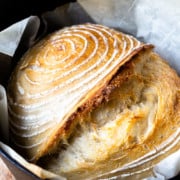
Easy Sourdough Bread Recipe
Simple sourdough bread recipe that is great for both beginners and experienced sourdough bakers! With just 35 minutes of hands-on time and an overnight rise, I created an easy, uncomplicated method of overnight sourdough bread. It's light, fluffy, chewy and flavorful on the inside with a crispy, golden crust.
Servings: 1 loaf
Calories: 1896kcal
Equipment
Ingredients
- 100 grams active sourdough starter
- 375 grams water
- 500 grams bread flour
- 12 grams salt
Instructions
Mix the dough
- If your kitchen is pretty warm, about 70 degrees or warmer, I recommend using only 75 grams of starter. In a large bowl, mix together the starter and water using a spoon or fork. Add the flour and salt and mix to combine until a shaggy dough forms. Cover with a towel and let rest for 30 minutes.
Stretch and fold
- Grab underneath one side of the dough and pull straight up to stretch the dough without breaking it, then fold over the center. Give the bowl a quarter turn then repeat again with the next side. Repeat this process until you've stretched and folded all 4 sides of the dough (think North, South, East, West). Cover with a towel and let rest. Repeat this stretch and fold process every 30 minutes over 2 hours, for a total of 4 times. The dough will tighten up as you go along. TIP: wet your hands with water to prevent the dough from sticking.
- NOTE: If you don't have time to stretch and fold for 2 hours, just do as many series of stretch and folds as you have time for.
Bulk fermentation (first rise)
- Cover the bowl with an air tight lid or plastic wrap then a towel. Let rise at room temperature for 8-12 hours, or until the dough has doubled or nearly doubled in size. Keep in mind, warmer weather will cause the dough to rise faster. If the dough more than doubles, it's not ideal, but it's OK - the bread will still turn out! The dough will just be a little sticker, making it slightly more difficult to work with.
- NOTE: Once you've tried this recipe, you can adjust the amount of starter to suit your needs. For example, for a faster rise, use 100 grams of starter, and for a slower rise, use 50 grams of starter.
Shape
- Use your hand to scrape the dough from the bowl onto a clean, dry surface. Shape the dough into a round ball by first folding it. To start, fold the left side of the dough over the center, then fold the right side over the center. Grab the top of the dough and fold over then center, then roll the dough down to the end.
- Using your hands or a bench scraper, push and pull the dough to create tension on the surface, this will help the dough hold it's shape.
Proof (second rise)
- Line a bowl or proofing basket with a towel and dust with flour (or you can dust the proofing basket directly). Transfer the dough to the bowl or proofing basket with the seam side up and smooth side down. Cover tightly with a towel and refrigerate for 12-24 hours, or at least 1 hour if you're short on time.
- NOTE: Refrigerating for 12-24 hours will yield the best results. Determine the length of time based on when you want to bake and eat the bread.
Preheat the oven
- Place a Dutch Oven with the lid on into the oven. Preheat your oven to 500 degrees.
Score
- Remove the sourdough from the fridge and remove the towel. Place a piece of parchment paper over the proofing basket or bowl, and place a plate over the parchment paper. With one hand on the plate and one hand on the bowl, flip the dough out onto the parchment lined plate. Gently remove the bowl, using your hands to help release the dough if it's stuck.
- Using a sharp knife, razor blade or bread lame, score the dough as you wish. I like to do one big slash down the left of right side of the dough or a simple X across the top.
Bake
- Remove the Dutch Oven from the oven and take off the lid. Grab the edges of the parchment paper and transfer it to the hot Dutch Oven. Cover and place back into the oven. Reduce the oven temperature to 450 and bake for 30 minutes. Remove the lid and bake an additional 10-15 minutes, or until the loaf is a deep golden brown color on top.
Cool
- Once the loaf has finished baking, remove from the Dutch Oven to cool. Let cool for at least 1 hour before cutting.
- NOTE: Cutting the bread too soon while it's still hot will result in tough, gummy bread. If you let it cool before slicing, the bread will be tender and light.
Notes
Baker's Schedule
Below is an example of a schedule that works well for me. Adjust the days to fit your schedule/needs, and remember that the times provided are not strict, just an example. Your times will change depending on how fast your starter rises, how long you do stretch and folds, and how long you cold proof.- Friday @ 12 pm: Feed your starter. Remove your starter from the fridge, and mix together equal parts starter, water and flour. Discard the remaining starter. I like to keep a discard jar in the fridge that I add to every week. Let your fed starter rise until doubled in size, about 4-6 hours.
- Friday @ 6:30pm: Mix the dough. You will mix part of your active starter with water, flour and salt. Return the remaining starter to the fridge.
- Friday @ 7pm - 9pm: Stretch & folds. Perform a series of stretch and folds every 30 minutes for 2 hours.
- Friday @ 9pm: Bulk fermentation. Cover the bowl with a kitchen towel and let rise overnight until doubled in size or close to. If it more than doubles, it will fine - the dough will just be sticker and a little more difficult to work with.
- Saturday @ 6-7am: Shape the dough. The dough will be loose and shaggy at this point. Shape the dough into a tight ball creating tension on the surface to hold it's shape.
- Saturday @ 7am: Cold proof. Proof the dough in the fridge for 12-24 hours (or at least 1 hour).
- Saturday @ 8am - Sunday 8am: Score + bake. Remove the dough from the fridge, score it and place into a hot preheated dutch oven, then bake it.
Storage:
- Room Temperature: Once the loaf has been sliced into, store in an airtight bag for up to 5 days. After a couple days, I think sourdough bread tastes best lightly toasted.
- Freezing: You can freeze sourdough bread in an airtight bag for up to 3 months. You can freeze the loaf whole or cut into slices first. I like to slice the loaf, then I can just grab one or two slices at a time and pop them into the toaster to thaw and toast before eating.
Nutrition
Serving: 1loaf | Calories: 1896kcal | Carbohydrates: 382g | Protein: 63g | Fat: 9g | Saturated Fat: 1g | Polyunsaturated Fat: 4g | Monounsaturated Fat: 1g | Sodium: 4681mg | Potassium: 501mg | Fiber: 13g | Sugar: 2g | Vitamin A: 10IU | Calcium: 89mg | Iron: 5mg
